
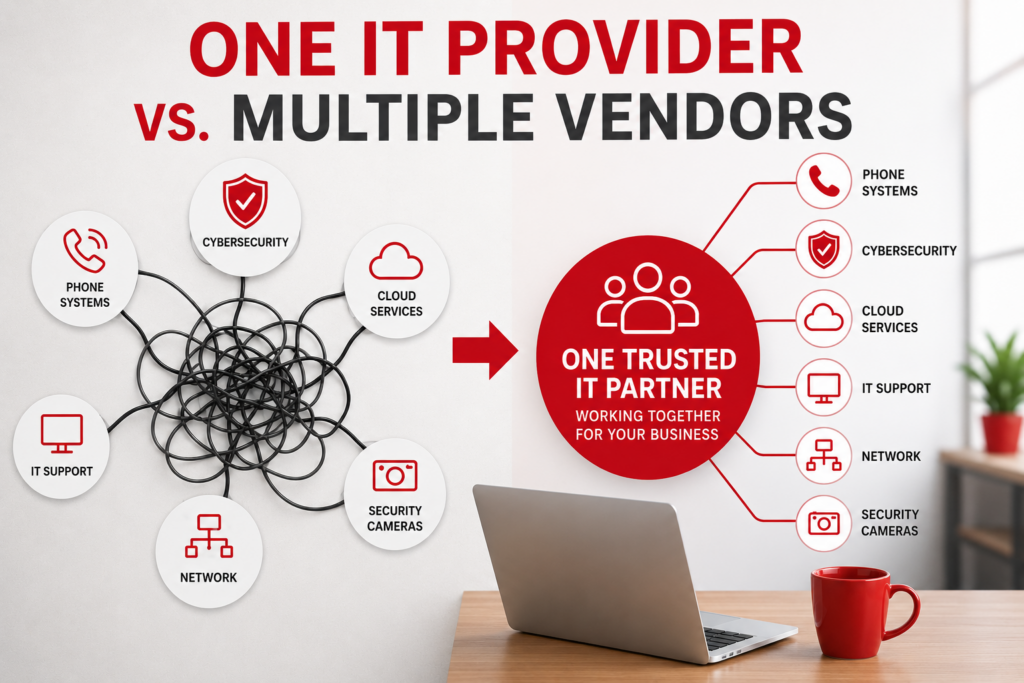
Most companies don’t set out to have three or four different technology providers.
Maybe the phone system came from one company years ago. The cybersecurity tools were added after an insurance requirement. An IT company was hired when the previous consultant retired. Security cameras and cabling came from someone else entirely.
Over time, it becomes a collection of vendors that each manage one piece of the puzzle.
The arrangement often works well enough until something stops working.
The Biggest Problem Isn’t Having Multiple Vendors
Having multiple vendors isn’t automatically a bad thing.
But managing disconnected technologies can quickly become a challenge. According to Barracuda Networks, 52% of organizations want MSPs to help manage the growing number of disconnected security tools and vendors. The 2025 study surveyed 2,000 senior IT and security decision-makers.
The challenge is determining who owns the problem when technologies overlap.
If phones stop working, is it the phone provider? The network? The firewall? The internet connection?
If remote employees can’t connect securely, is it the VPN, Microsoft 365, endpoint security, or your IT provider?
When every company supports only its own product, troubleshooting often turns into finger-pointing.
Meanwhile, your employees are waiting to get back to work.
What Happens When One Team Manages Everything?
When one provider supports your IT, cybersecurity, phones, and network infrastructure, they already understand how everything works together.
Instead of coordinating between multiple vendors, you make one call.
The same team can identify where the problem actually exists and resolve it without bouncing you between support desks.
It also creates consistency in areas like:
- Security policies
- User onboarding and offboarding
- Vendor management
- Technology planning
- Documentation
- Ongoing support
There Are Times Multiple Vendors Make Sense
An all-in-one provider isn’t always the right answer.
Large organizations may have dedicated internal IT departments or specialized requirements that call for niche providers.
Some businesses also have industry-specific software or equipment that requires direct vendor support.
The important question isn’t how many vendors you have.
It’s whether someone is responsible for making all of those technologies work together.
Questions to Ask Before Choosing an MSP
Rather than focusing only on response times or monthly pricing, ask questions like:
- What technology do you manage directly?
- Do you support business phone systems?
- Can you manage cybersecurity as well as IT support?
- Will you work with our existing vendors if needed?
- Who coordinates issues that involve multiple systems?
- Do you help with long-term technology planning or only day-to-day support?
The answers often reveal whether you’re hiring a help desk or a long-term technology partner.
Further Reading: How to Choose a Managed Service Provider
Just Solutions Makes Managing Technology Easy
There’s nothing inherently wrong with working with multiple technology providers.
But when every critical system depends on the others, having one team that understands the entire environment can save time, reduce frustration, and make technology easier to manage.
At Just Solutions, that’s the approach we take. We support managed IT, cybersecurity, business phone systems, network infrastructure, and the technology that connects them, so when something needs attention, you know exactly who to call.